
DNA paper RETRACTION update: We received a new email about our paper that is "under investigation"
Retraction Watch apparently has the reviewer comments from our peer review process - these are meant to be confidential, no?

I woke up the other morning to the next step in the retraction attempt on our seminal paper published in Autoimmunity entitled: Quantification of residual plasmid DNA and SV40 promoter-enhancer sequences in Pfizer/BioNTech and Moderna modRNA COVID-19 vaccines from Ontario, Canada.1
Here’s the ongoing timeline:
September 6, 2025
We published online.
For those of you unaware, within just over a week of publishing our paper, we received an email notification from the publisher of the journal that our paper was “under investigation” prompted by “pubpeer commenter” Kevin Patrick under the pseudonym Actinopolyspora biskrensis. You can read about that here.
September 17th, 2025
The first email came:

Patrick falsified a claim by misquoting another peer-reviewed article published by Klinman et al..2 Yes, you read that right. This is where we’re at.

We have been under incessant attack since we published. Let me be clear: WE’VE ALREADY BEEN THROUGH PEER REVIEW, AND PASSED ONTO FULL PUBLICATION. And this was after many desk rejections with many other journals. We’ve addressed countless issues raised and responded more than adequately to all of them, either with benchwork or references.
October 22nd, 2025
The next email came:
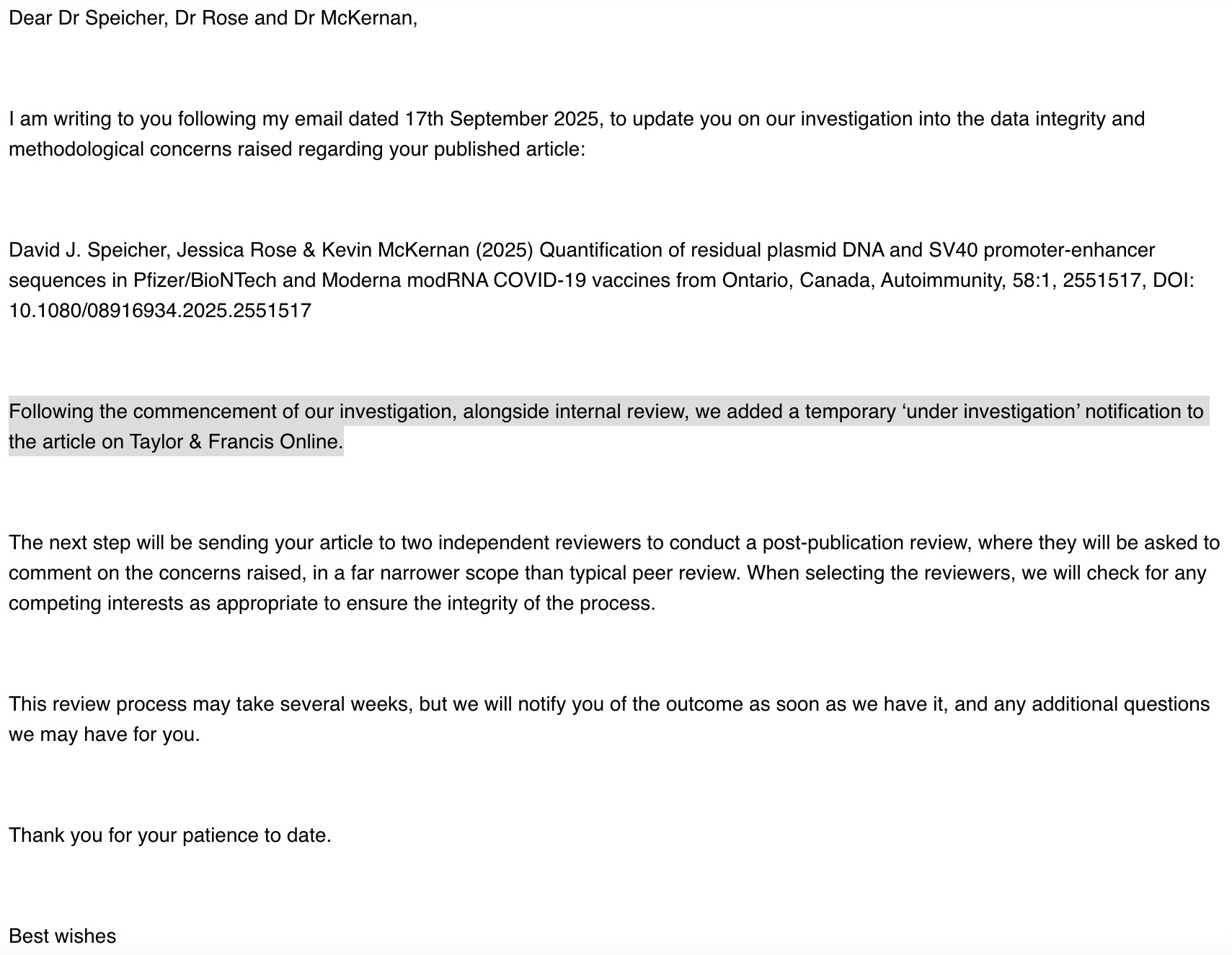
Best wishes.
November 20, 2025
And then the email from a Retraction Watch journalist came:
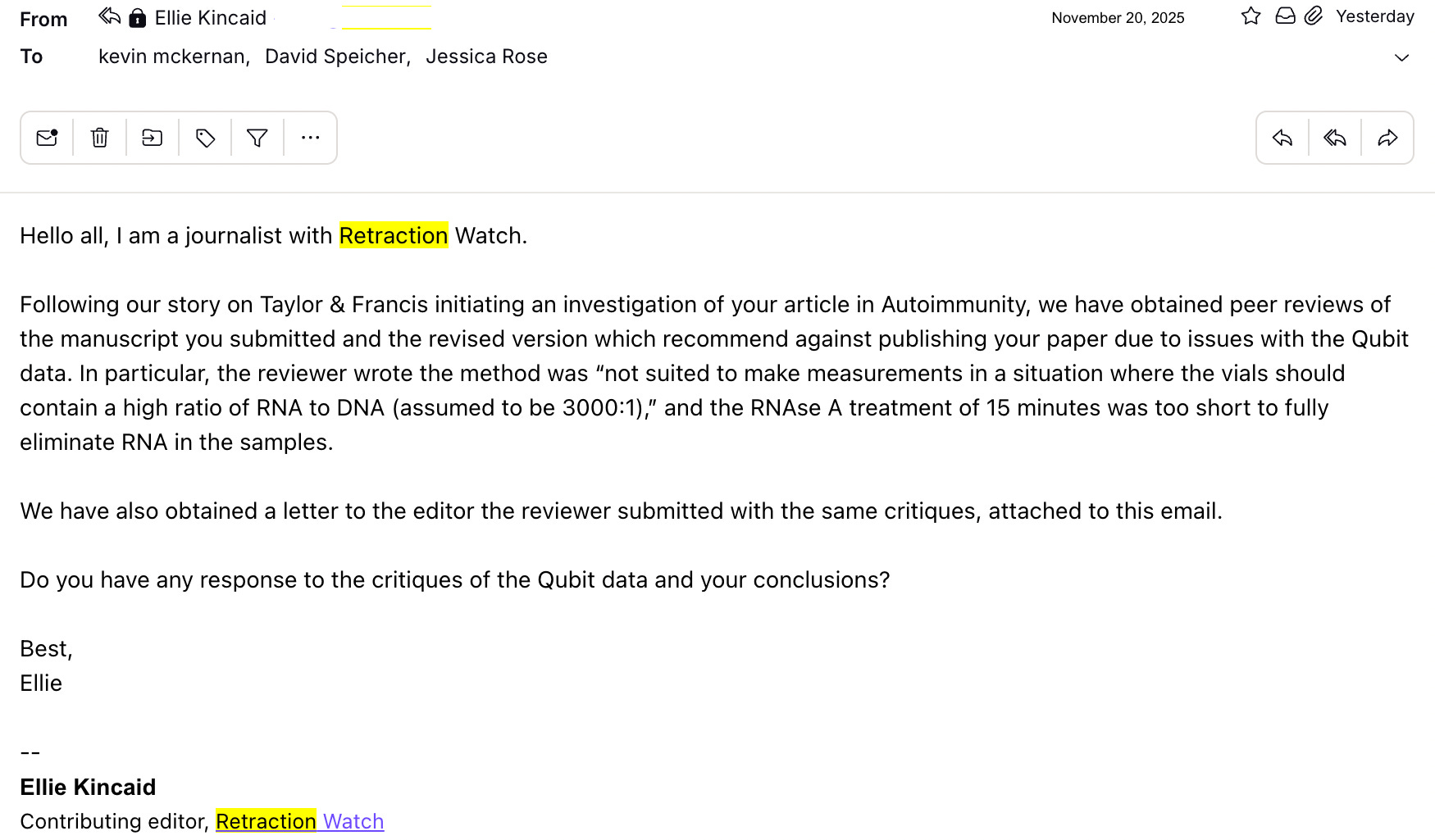
This email had an attached pdf where the undisclosed whiner/author uses ad hominens and regurgitates false claims. It is interesting to me that the name of the attached pdf is Letter_to_the_Editor_VACCINE, as opposed to the perhaps expected Letter_to_the_Editor_AUTOIMMUNITY. Seems like this might in reference to a previously written (perhaps carbon-copied) letter to the editor.


This email from Kincaid claims that the reviewer is also the person who forwarded a letter to the editor with the “same critiques”. Who is this person who believes they have the authority to question a published article that’s been through peer review and to opinionate “further editorial action”?
And is this really one of our reviewers?
From a glove-face-slapping point of view - this is an insult to us as authors, to the journal, the editor and all the peer reviewers who spent long hours to make this article scientifically sound, even the one who seems hell-bent on getting our paper retracted, if this is the case.
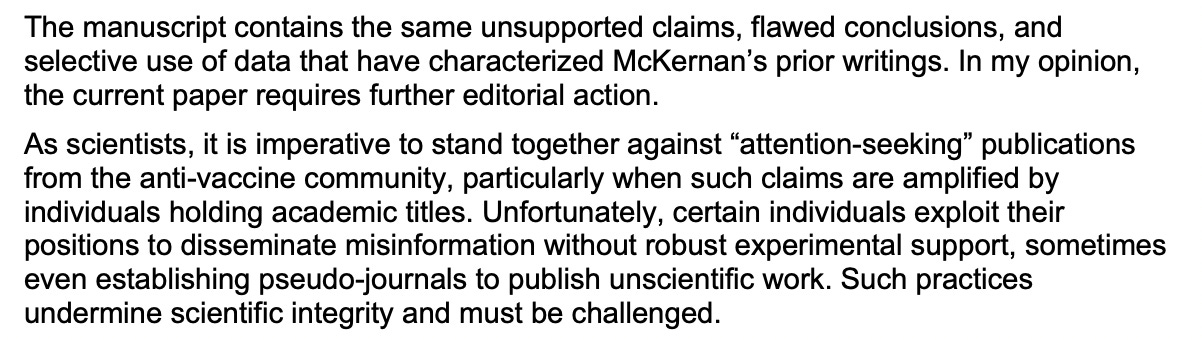
“Attention-seeking”? “Anti-vaccine”? “Exploit their positions”? “Misinformation”? “Pseudo-journals”? Well, that last word has a particular individual’s name all over it and I imagine that he is referring to James Lyons-Weiler’s journal Science, Public Health Policy and the Law and/or the Independent Medical Alliance’s Journal of Independent Medicine. Most likely, the former.
AHEM. The author’s name is in the pdf sent to us. Right click: ‘Get info’.

I have a very serious question now regarding the email.
Question: How is it possible that this journalist got his hands on the peer reviews for our paper? Did one of our reviewers indeed pass his review onto Retraction Watch and write a letter to the editor to prompt retraction of our paper once it got through peer review? We are not privy to seeing these as they are confidential so as to prevent reviewer name disclosure. Confidentiality, however, depends on a chain of human and technical safeguards, and that chain appears to have been broken if what Kincaid wrote is true:
…we have obtained peer reviews of the manuscript you submitted and the revised version which recommend against publishing your paper due to issues with the Qubit data.
This is a serious ethical breach and/or a civil wrong (breach of contract, copyright infringement, breach of confidence) and once again, I have to ask why, after we’ve been through peer review, does some anonymized individual - who doesn’t have to state COIs or even their name! who according to Kincaid was one of our reviewers - have the power to a) incite an investigation into a published paper and b) access confidential documents and use them to re-peer review a published paper by complaining to the editor of the journal whilst using ad hominens rather than addressing actual issues?
Is this REALLY how peer review works?
Just for the record, COPE (Committee on Publication Ethics) has clear guidelines on confidentiality for peer review, and it specifically addresses the issue of forwarding reviewer reports to third parties. According to COPE, reviewer reports must remain confidential, and forwarding them to third parties without permission is a breach of ethical conduct.
Stay tuned.
Speicher, D. J., Rose, J., & McKernan, K. (2025). Quantification of residual plasmid DNA and SV40 promoter-enhancer sequences in Pfizer/BioNTech and Moderna modRNA COVID-19 vaccines from Ontario, Canada. Autoimmunity, 58(1). https://doi.org/10.1080/08916934.2025.2551517
Klinman DM, Klaschik S, Tross D, Shirota H, Steinhagen F. FDA guidance on prophylactic DNA vaccines: analysis and recommendations. Vaccine. 2010 Apr 1;28(16):2801-5. doi: 10.1016/j.vaccine.2009.11.025. Epub 2009 Nov 24. PMID: 19941989; PMCID: PMC2847045